|
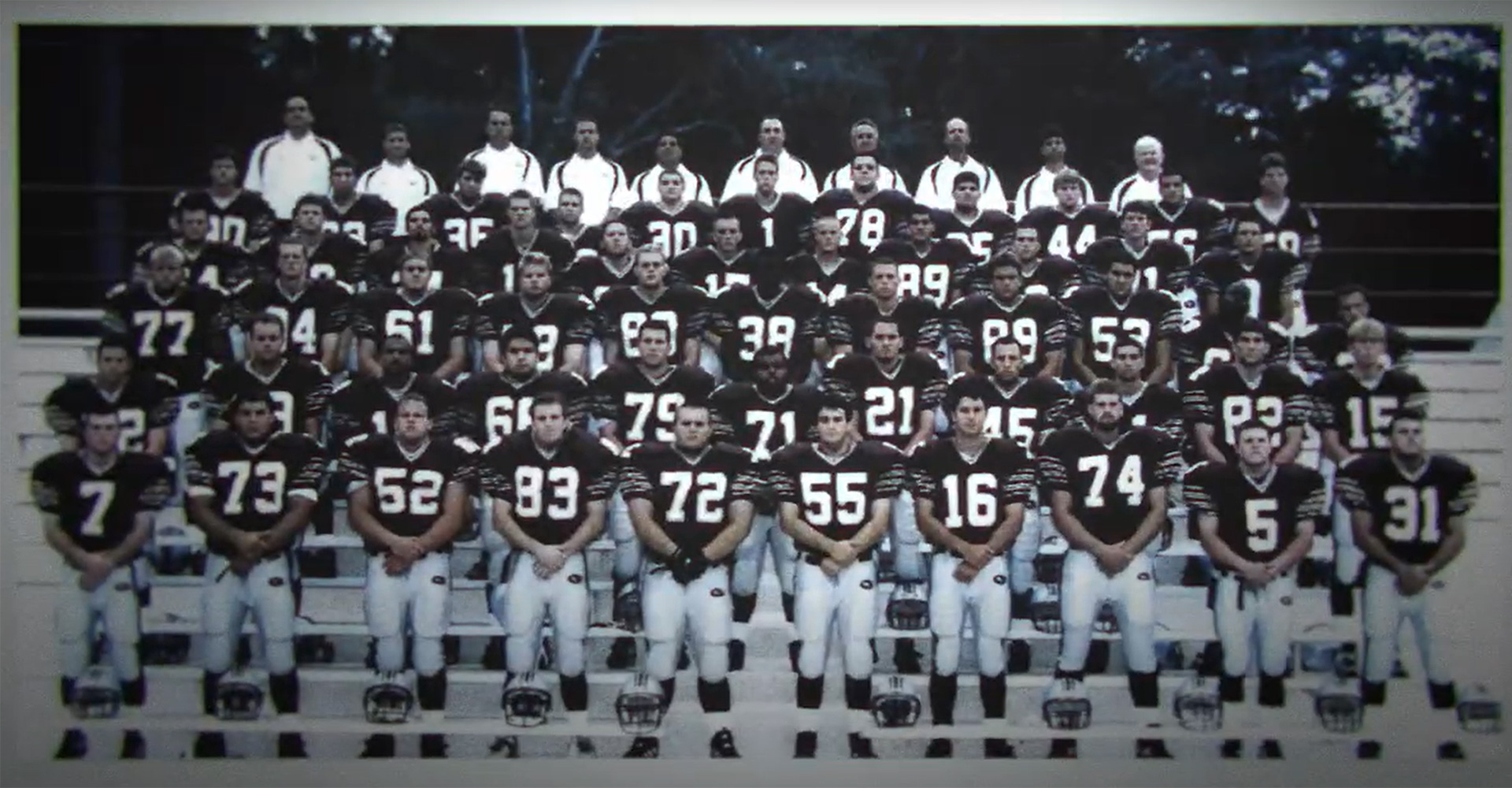
| The final seasons of Swarthmore football had varying levels of success until their 2000 team went 4-5, then had the program cut out from under them. Swarthmore file photo |
In a decision that drew headlines from the New York Times and television networks and newspapers across the country, Swarthmore announced 25 years ago this week that it was dropping the sport of football.
Football's tenure of more than a century at the liberal arts college in the suburbs of Philadelphia had been marked by a bitter rivalry with Haverford (before Haverford dropped the sport in the 1970s), then a 28-game losing streak which the team snapped by defeating Oberlin in 1999. But the program was on the upswing in 2000, no longer needing to take on a fellow struggling program to get a win. Swarthmore won four games in 2000, going 4-5 on the year, and defeated Washington and Lee in their season finale.
But dark days were coming, as the school's Board of Managers voted after that season to drop the sport, along with wrestling and women's badminton. The fact that the issue came to a vote at all was unusual; as a school with Quaker roots, such decisions were traditionally made by consensus. But no consensus could be reached when people wanted the program killed.
Our coverage from December of 2000 continues below, including the news story from the day the news broke, and a Q&A with Swarthmore's final coach, Pete Alvanos.
Swarthmore drops football
 Freshman football player Tim Lang holds a candle at a rally organized by his team.
Photo by Claire Weiss, The Phoenix |
The much-anticipated Jan. 4 meeting by the Swarthmore Board of Managers resulted in the same decision – football, badminton and wrestling will be dropped at Swarthmore College.
After 120 seasons, Swarthmore football is no more.
"There is a feeling on the part of the board that only 15% of the student body should be athletes," team captain Scott Murray told the Philadelphia Inquirer. Alvanos, who recently completed his third season as head coach, said, "at Princeton, for example, 17% of the freshman class is recruited athletes.
| Swarthmore's lasts Game: at Washington & Lee, Nov. 11, W 16-6 Play: took a knee to end game Rush: Ken Clark 3-yard run, 1:06 left Interception: Donovan Godley, 1:13 left Tackle: Kevin Perry, 1:20 left Score: Robert Castellucci 23-yard FG, 5:02 Touchdown: Clark 2-yard run, 12:01 |
"When I took the job, I was told there was a commitment on behalf of the college to turn the program around," said Alvanos. Swarthmore currently has 30% of its students participating in intercollegiate athletics, but it is unclear what percentage are recruited to the athletic program. Wrestling and women's badminton were also cut at the suburban Philadelphia school.
"It hurts, real bad," Alvanos told students at a rally the night of the decision. "You uproot your family, your wife and three kids, and assistant coaches uproot their wives and kids, and you look freshmen and high school seniors in the eyes and tell them that the college is behind you, that there's 100% commitment to turn the program around and do the things the right way. And we've done that, everything that (college president) Al Bloom has asked us to do."
The move reduces the Centennial Conference to seven football-playing schools, but leaves the conference eligible for an automatic bid. Swarthmore had played longtime rival Washington & Lee and Oberlin in non-conference action.

Swarthmore head football coach Pete Alvanos cries while addressing the crowd at a Saturday night rally.
Photo by Claire Weiss, The Phoenix
|
D3football.com: Two Saturdays ago word came down. Why don't you describe the situation for our listeners.
Pete Alvanos: We knew this committee was formed and that they were going to look at the overall athletic program. So we were kind of in limbo, so to speak, before recruiting started because the committee was meeting about certain recommendations. Then on the 15th of November we got the green light to go out on the road, recruiting for next season. Things looked good at that point in time. It was the Thursday right before two Saturdays ago – my dates are running into each other – I got a phone call, I'm on the road, down in Maryland recruiting, and basically it was from the provost, who said 'Coach, you have to come off the road, I have to meet with you.'
I met with her late Thursday afternoon and she had said to me that the committee had an emergency meeting and that they were going to recommend to drop football, purely based on numbers. 'It had nothing to do with Pete Alvanos, or the way we coached our teams, or anything that happened on campus' – not that anything did happen. She said 'Coach, this is not a definite, the board is going to have to vote on it,' that weekend.
At that point in time I still felt somewhat comfortable because I knew the Quaker consensus philosophy and things of that nature. So I really wasn't nervous because I knew there would not, I didn't think there would be a consensus on the Board. Neil Austrian and [unintelligible] were two Board members that I met with prior, they're the ones that kind of talked me into taking the job 2½ years ago. I went out to lunch with both of those men on Friday and they said 'Coach, we'll come and see you on Saturday with the outcome.' And lo and behold it was 1:00 on Saturday afternoon, and the door opens and there's Neil Austrian and I stand up and he says 'No no, coach, you need to sit back down.' And that's when he says 'Coach, we lost. They're dropping football.'
At first you're numb, you're in shock, but the more these guys started talking about everything, the discussion and so on and so forth, it was real. When they left I just sat in my office and basically cried, because I'm sitting here thinking we finally turned the corner with the program and we were getting our numbers [of players] increased while maintaining the higher academic standards of Swarthmore. The hardest phone call I had to make was to my wife and to tell her what exactly happened and then the phone calls just went to my parents and to the staff... and it was just a trying day, to be honest with you, because you never want to believe that a program's going to be dropped on your watch. You put your heart and soul and energy into building something basically from the ground up, and this was just a decision that the board felt and this committee felt was right for the institution. It just comes as a shock to everyone.
D3: I've seen the team first-hand here in the Centennial Conference and the turnaround with the team was tremendous. The game I saw against Dickinson was a Swarthmore loss, but that was a good game. Ken Clark, the freshman running back, first team all-conference, the Garnet went 4-5 this season. It came as a complete shock to me having seen the team for the past two years and the turnaround that you and the coaching staff made and the quality of players you got in there. Did it hurt more knowing the quality of a team you really had?
PA: That's what hurts the most. We beat every bush and turned over every stone we could possibly turn over to find the quality scholar-athlete we have on our team, that is first-rate in the classroom and first-rate football players. I said to my wife the other night, 'The thing that I'm going to live with for the rest of my years is that I'll never know if we could have had a winning season at Swarthmore.' While I think we would have won 5, 6 or 7 games next year – I really believe that because we only graduated six seniors and we only lost two starters on defense and one on offense. That's the thing that's just going to eat at me because I just felt like we were right there. I'm not going to say that we would have competed for the conference championship but certainly could have been in the top three or four. I really believe that in my heart. That's what I struggle with on a personal level.
D3: How great was it as a coach to have the feeling that when Swarthmore came in to play people weren't always saying, 'We're going to come in and wipe the floor.' That didn't happen this season and the team really garnered respect.
PA: I appreciate it and that's something we took pride in as a coaching staff and the kids took pride in. They worked so hard in the offseason to get things done, to lift, and to do all the things that obviously, you can't make anyone do in Division III. They took that on their own. They had an offseason meeting and made a commitment to each other that they didn't want to be the laughingstock of Division III football, or of the Centennial Conference anymore. They saw how committed we were as a coaching staff and they wanted to be just as committed as players. If we had one compliment this year, we had a hundred about how much more physical our kids were and what better shape we were in, and it was all the kids. It was their desire to get into the weight room and lift and make a legitimate commitment to being competitive and winning some football games.
D3: Far from where you were over a year ago, and if anything you guys have become the heart and soul of Division III football, even in the absence of an actual team now.
PA: Well, I appreciate it, and like I said, the calls have been coming in from coaches throughout the country, which I'm greatly appreciative of, and just Division III fans, because of your Internet service that you supply, we're getting letters and e-mails and I'm just very grateful for those people out there who are making a plea or a case to the president and to the provost and even to the Board of Managers. At this point in time, we'll just have to see. I know the alumni are really working hard, and the players and parents, to try to get the board to possibly meet again and maybe reinstate the program. I don't know how realistic that is at this point, I don't know what the odds are of that happening, but I know there are some people behind-the-scenes that are really making a push for that to happen.
D3: I know there are and that the entire Division III community is behind you, but let's talk about the future for a second. If this does not get reinstated, how many players do you envision transferring out of Swarthmore and where do you see yourself going?
PA: At this point in time, as the players have come to us we've been granting transfer releases to as many kids as come to us. We probably have anywhere from 15 to 20 players who have come to us as a staff to say they'd be interested in a host of schools, whether it be Amherst, Williams, the University of Chicago, Washington & Lee, Johns Hopkins. There's a number of schools that our kids are interested in, because they came here obviously for the great academic institution that it is, but they also came here to play football and be a part of building something. They've played the game their whole lives and they want to continue playing. So that's where we're at. I would envision about 15 or 20 or so transferring.
As far as personally, I don't know what I'm going to do right now. I've been talking with my wife and I'm just not real sure. I sort of do want to coach again and there are some things out there that I would possibly pursue. But at this point in time I just want to sit down with the president and see exactly what his thoughts are and things of that nature and certainly make a decision that's best for my family and me.