|
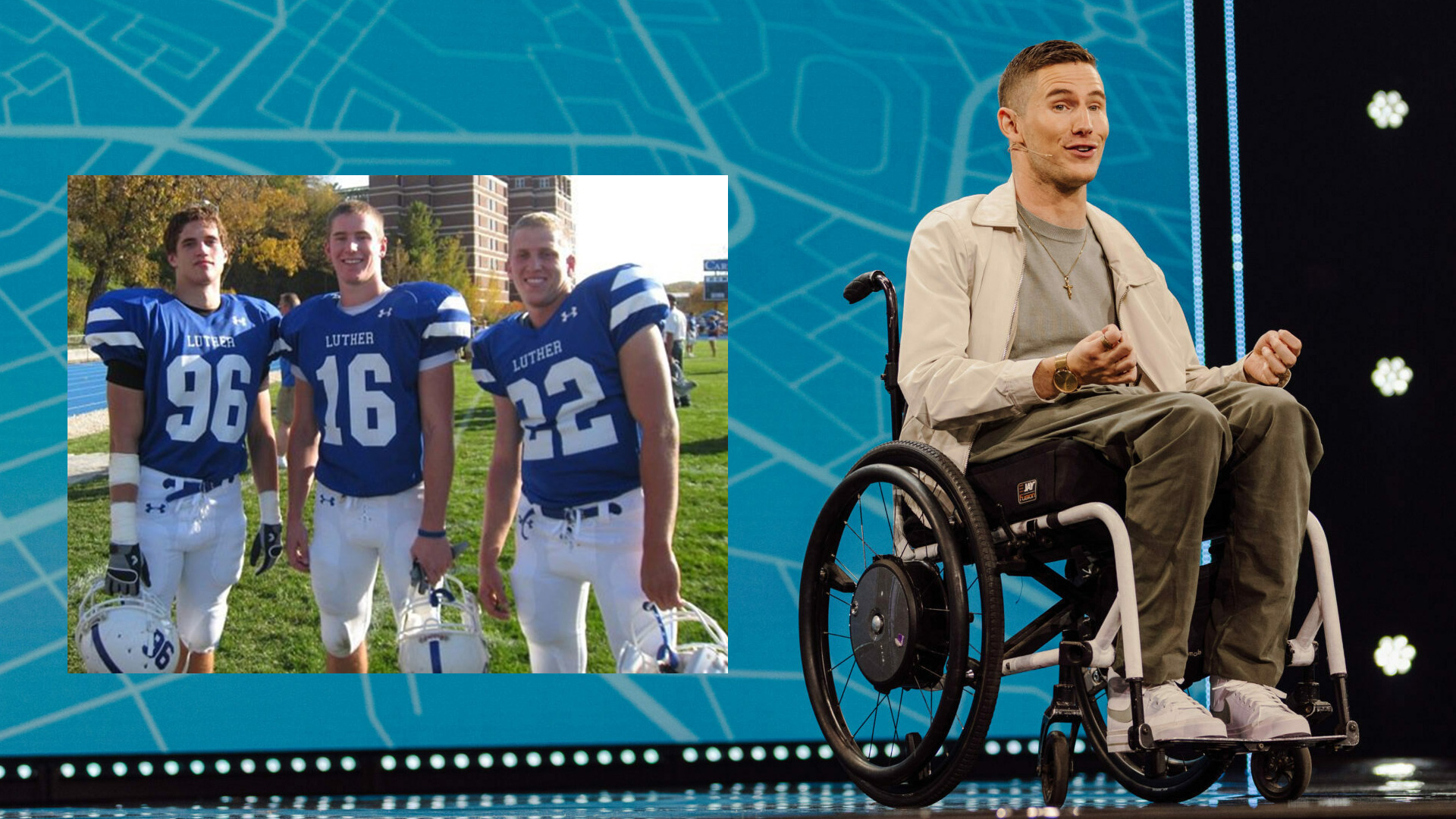
| Chris Norton, wearing No. 16 in the inset photo, had a short career in a Luther Norse uniform which ended with an injury 15 years ago this week, but has turned his story into a motivational speaking career and a foundation. 2010 photo; ChrisNorton.org |
By Glen Crevier
D3sports.com
On Oct. 16, 2010, Chris Norton awoke and prepared for the day ahead.
He was a freshman football player for Luther College in Decorah, Iowa, a private school that played Division III athletics. That day’s opponent was Central College, a conference rival.
Chris was excited about the game because as a first-year player, he had cracked the varsity and became a regular on the kickoff coverage unit. No more JV games on Mondays. He was second team strong safety and learning to play free safety. It was heaven.
Before leaving for the game, Chris packed a bag for an overnight trip to a teammate’s house. During the warmups, as they were doing high knees and karaoke drills, the teammates joked about not wearing themselves out in the drills because they had a big night ahead of them.
|
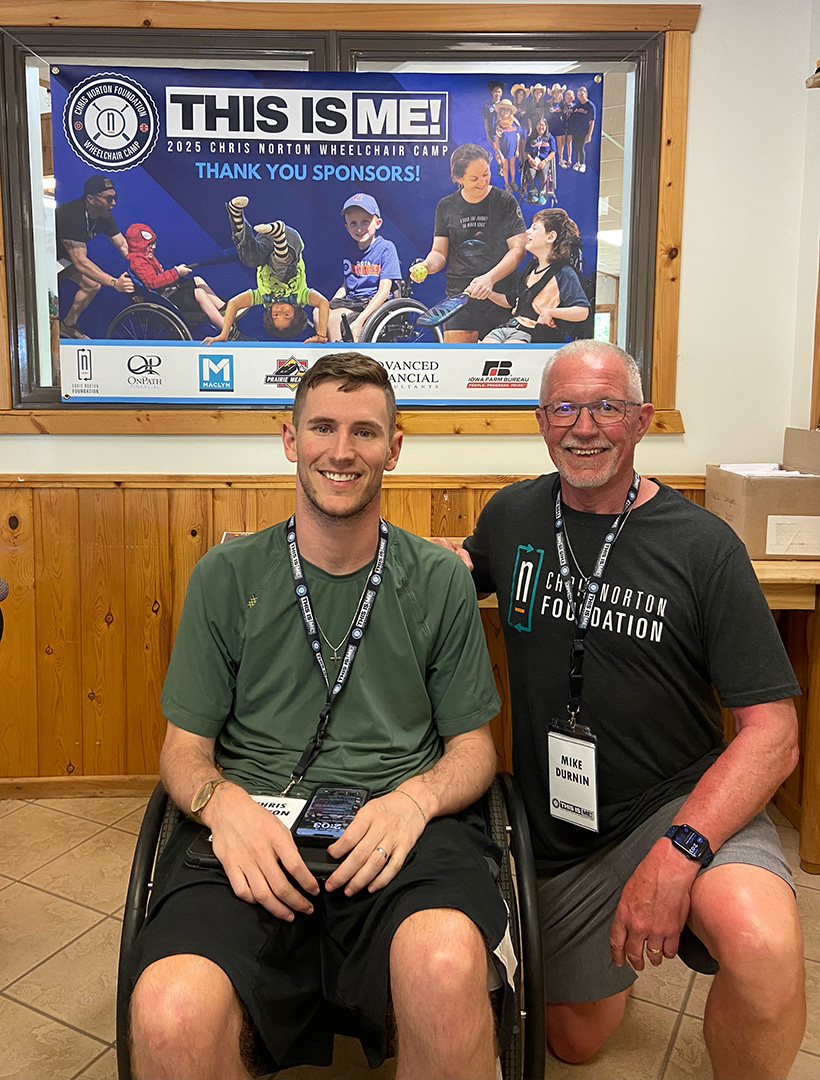
| Chris Norton and his former coach, Mike Durnin, help lead Norton's philanthropic work. Provided photo |
In the third quarter, as Luther was mounting a comeback in what eventually became a 45-26 loss, Chris ran onto the field for the kickoff, feeling “completely invincible.” A moment later, while making a full-speed-ahead tackle, he was paralyzed from the neck down.
He would never walk again on his own – though with aid he can stand and walk for short stints – as he did when he walked across the stage for his diploma and later down the aisle when he married his wife, Emily. He described his injury as “incomplete quadriplegia,” with slight movement in his biceps and triceps, very weak hands and wrists, some dull sensations and strength in his legs.
But this is not a story about a life ruined by a tragic moment on the football field. Rather, it is a story about hope, faith and perseverance. In some ways, it’s a story about a miracle. Not only for Chris, but for others whose life he has touched.
As often happens with tragic stories, the headlines eventually fade. And in a world of immediacy, the subjects are too soon forgotten.
But Chris Norton, now 33, has not gone away. Nor is he forgotten.
Today, he heads the Chris Norton Foundation, which has raised more than $2 million to help people with spinal cord and neuromuscular disabilities. He hosts the annual Chris Norton Wheelchair Camp near Rochester, Minnesota, where families living with disabilities connect for a week of experiences like ziplining, laser tag, horseback riding and music. And through his work as a renowned public speaker, his book, The Seven Longest Yards, and the Netflix documentary of the same name, he is transforming his tragic moment into a lifetime of influence.
He describes himself first as a father and husband and second as an entrepreneur.
Chris and Emily have adopted five children – ages 7 to 16, and they have fostered 23 more. His speaking business is having its best year yet, and he is frequently on the road at events, sharing his story and motivational talks. He has spoken at schools, conferences and in front of employees at Microsoft, Fox Sports, the NCAA and the San Francisco 49ers, among a long list of others.

|
| Attendees at the 2025 Chris Norton Wheelchair Camp. Provided photo |
In the words of three people – Chris, his father Terry, and his coach at Luther, Mike Durnin, here are some of their thoughts that linger about the events and aftermath of Oct. 16, 2010.
Chris Norton
“In the third quarter we were getting our butts kicked. We had just scored a touchdown cutting it to a two-score game. So I run out to the field for the kickoff. At 18 years old I felt like I was on top of the world. Just completely invincible. You have these big dreams and plans that I was going to be this All-American football player, marry the girl of my dreams and then make enough money to buy a lake house. But anyway, back to the game. I'm sprinting down the field as hard as I can go. I see this opening. My instincts are telling me the ballcarrier is going to try to run through the gap. But I'm not going to stop. I'm going to destroy him. That was my football mentality, which is why I was perfect for the kickoff. They only put lunatics out there. Full speed, full force. So we collide, but instead of taking him down with my shoulder like I've done thousands of times, I accidentally hit him head-on and the next thing I know I’m face down, motionless, and I can't get up.’’
Mike Durnin (then-Luther coach, now president of the Chris Norton Foundation)
“I had been told Chris had a 3 percent chance of regaining movement below his neck. After the game, I’m talking with my team when I hear a helicopter. I knew right away it was a life-flight helicopter. In Decorah, Iowa it’s either that or they’re coming to spray the crops. I knew it wasn’t that. After we wrapped things up as a team, I drove directly to the Mayo Clinic. When I walked into the waiting area, I saw one figure: Chris’ mom Deb. Seven months prior, in the recruiting process, I sat down with her at lunch and as football coach I told her I would take care of her son. He’s in good hands with me, I said. My mind goes back to that moment and I realized I had failed as a coach. I thought she would hit me or yell at me. But she gave me a hug and said, ‘Mike, they give him a 3 percent chance. We are going to believe in that 3 percent.’ ”
Chris Norton
“I start to panic, not because I think I'm seriously injured but because I don't want the game to stop for me. That’s embarrassing for a wannabe tough guy. But eventually the athletic trainers come out. They roll me to my back. They are asking me questions like, ‘Chris can you make a fist with your hand.’ I couldn't. ‘Can you feel touching on your leg?’ I couldn't feel a thing and that's when it slowly seeped in that this might be serious. This could be really bad. I've always lived with a glass half-full mentality, optimistic that things are all going to work out.
“I kept my eyes closed to block out reality. I was trying to escape and avoid that this could be my life and there's something obviously bad happening. I just didn't want to accept it. My parents came down. They're trying to reassure me, but I can hear the worry in their voices. I knew they were just as scared as I was. I got on the stretcher and was wheeled across the field and then flown out to Mayo Clinic. When I got to the surgery room, the surgeon asked ‘Do you have any questions?’ I was too scared before this point. I asked ‘Will I walk again?’ He just shrugged his shoulders and said, ‘I don't know.’ I couldn't hold back my tears any longer.”
Terry Norton (Chris' father, executive director of the Chris Norton Foundation)
“About a year after his injury, Chris had been asked to speak to a group about what he had gone through. Chris assumed that everyone had the latest and greatest medical equipment, like he did. He found out that was not the case. He benefited from an NCAA catastrophic insurance policy. He’s a go big or go home type of guy. Someone asked him if he were given money what he would do with it. He said he’d use it to help other people. That’s when the idea struck. He said to me, ‘Let’s start a foundation.’
Previous coverage |
“So he started a foundation that really has two functions. We put on a wheelchair camp and we started a fundraiser event, a dinner and auction, that raises money to help families with long-term health and wellness issues, rehab equipment. Last year we raised $260,000. Local hospitals and rehab facilities apply for grants and if approved we make awards. For me, it’s a labor of love.
Chris Norton
“My job now, my purpose, is to help organizations and people grow stronger through change. My message is that you need to learn to embrace adversity. When I began sharing my story, I realized that people were really leaning into it. I realized that my pain could be used for a greater purpose. I was at an event and someone suggested that I should take public speaking seriously. That just blew my mind. I mean, people get paid to speak and inspire others? People were laughing and crying when I told them my story and my message. I realized that was my mission. That’s what I’m supposed to do.”
Mike Durnin
“Chris comes from a very strong family. Not once have they allowed this to become a tragedy. He made a choice to live his life to the fullest with a positive attitude and effort. His message is basically. ‘Don’t let circumstances limit you.’ He goes around the country now and people are inspired by what he has to say.”
|
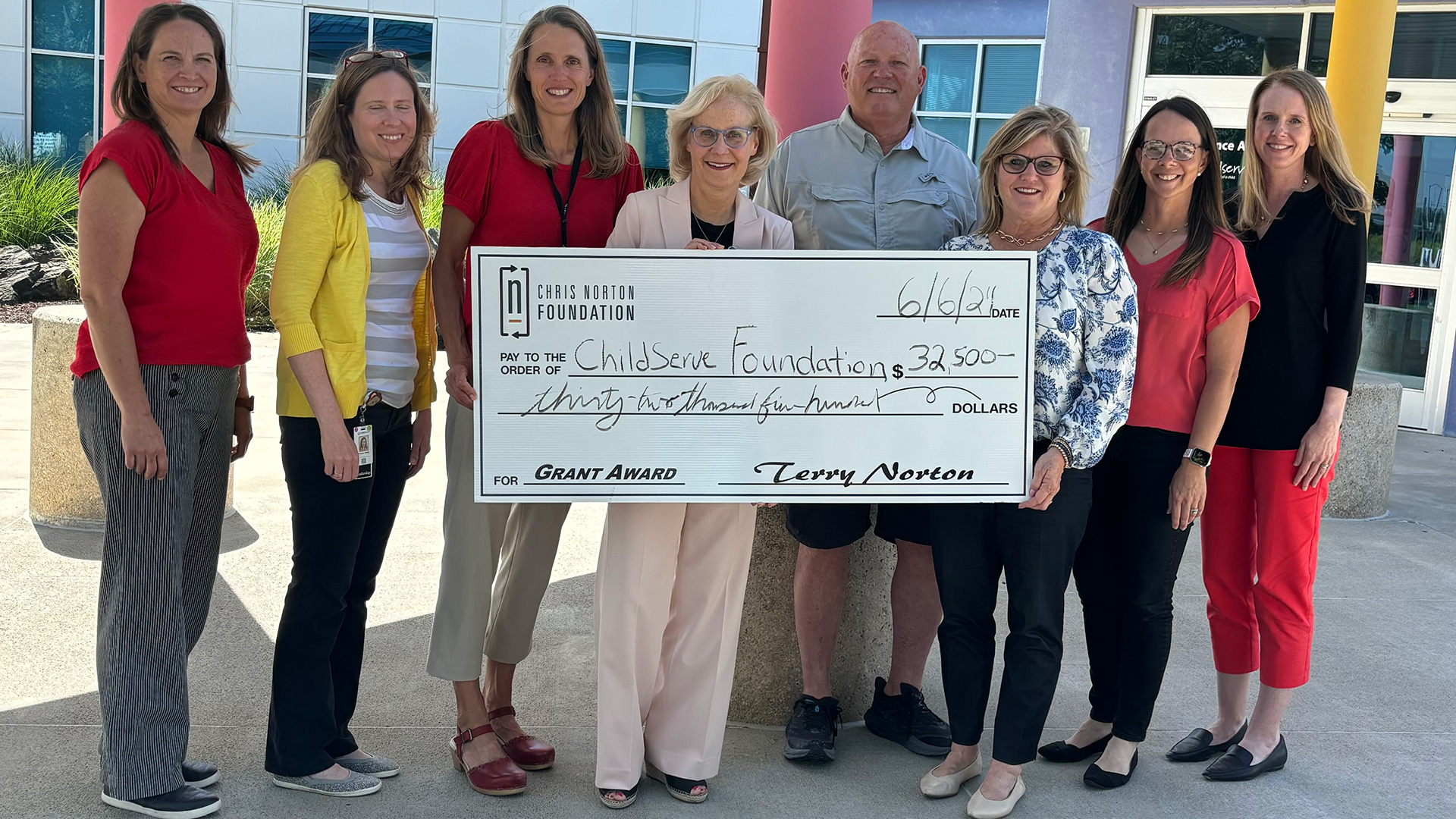
| Terry Norton, center-right, presents a check from the Chris Norton Foundation. Provided photo |
Terry Norton
“Our hope and faith were really tested. As a parent, the worst thing is to see your son, an able-bodied 18-year old athlete, suffer that type of injury. I’m very proud of him now. I do believe that the type of kid he was, the traits he had, have enabled him to go through all that he has gone through. Nothing ever came easy for him. He was used to success. He scored over 1,000 points in high school basketball (at Bondurant-Farrar High School near Des Moines), and he competed in state track. He had a lot of success in football. But he had to work so hard. And he still is like that. Even now, when he’s speaking, and as accomplished as he has become, he’ll say, “Dad, tell me three things where I can improve my presentation.’ This is now his life and he wants to perfect his craft.”
Chris Norton
“After my injury I had to really work hard not to lose myself. A lot of my identity was wrapped up in being a physically strong person. That was my self-worth. I just couldn’t lose the character and determination that made me who I am. The lessons I learned playing football are invaluable and they’ve helped me become who I am now. To not have played the game … well, I’d take that risk again.”


